7 minute read
GR00T N1.7 runs 24.6% faster on H100 with Fenon.
Fenon runs NVIDIA’s GR00T N1.7 in 16.1 ms per action chunk on an H100. NVIDIA’s optimized TensorRT path takes 21.3 ms on the same machine.
GR00T N1.7 is NVIDIA’s open foundation model for robot manipulation. Each call takes camera images, the robot’s state and a language instruction, and returns a chunk of actions. While that call runs, the robot keeps acting on the previous observation, so inference latency directly affects control.
We ran the same GR00T N1.7 checkpoint on the Fenon runtime and on NVIDIA’s optimized TensorRT path, on the same GPUs with the same inputs. On H100 we didn’t change the weights, the numerical precision or the four denoising steps.
- Lower median latency than NVIDIA TensorRT on H100
- 24.6%
- Speedup on H100, p95 down from 21.64 to 16.33 ms
- 1.33×
- Lower median latency on A100, 1.75× the calls per second
- 42.8%
- Gripper decisions changed; worst action error +0.36%
- 0
Results.
We timed 180 complete calls per runtime, from raw camera frames to decoded actions, alternating between the runtimes across three processes.
H100 · GR00T N1.7 LIBERO
A100 · GR00T N1.7-3B DROID
| Metric | NVIDIA TensorRT | Fenon runtime | Change |
|---|---|---|---|
| H100 median | 21.34 ms | 16.08 ms | −24.6% |
| H100 p95 | 21.64 ms | 16.33 ms | −24.5% |
| A100 median | 68.48 ms | 39.18 ms | −42.8% |
| A100 p95 | 70.55 ms | 41.60 ms | −41.0% |
| A100 throughput | 14.6 calls/s | 25.5 calls/s | 1.75× |
On both GPUs the p95 fell by about as much as the median: 24.5% on H100 and 41.0% on A100.
Inputs and output quality.
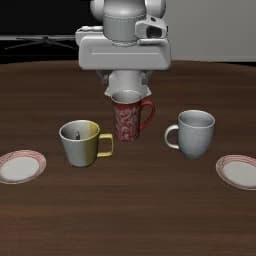

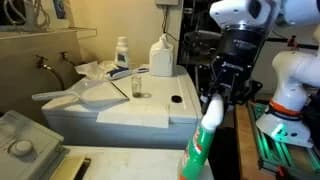
Each call gets fresh images, state and noise. Nothing is cached between calls. We fixed the quality checks before timing anything: compared with NVIDIA’s output, actions had to keep a cosine similarity above 0.999, no action dimension could degrade by more than 1% against the recorded demonstrations, and no gripper open/close decision could change.
| Check | Limit | H100 | A100 |
|---|---|---|---|
| Minimum cosine similarity | > 0.999 | 0.9999968 | 0.99966 |
| Largest error change in one action dimension | < 1% | +0.36% | +0.13% |
| Gripper decisions changed | 0 | 0 | Not measured |
Where the time went.
We profiled NVIDIA’s path before changing anything. On A100, the GPU was idle for the first 12.2 ms of each call while the CPU prepared images, and for the last 11.2 ms while the CPU decoded actions. On H100, no kernel was running for 9.5 ms of a 22.7 ms profiled call.
Most of our changes target that idle time:
Scheduling. The vision, language and action stages are queued on the GPU back to back. The CPU waits once, when the actions are ready, instead of after every stage.
Repeated work. Some work ran on each of the four denoising passes. It now runs once per call.
Input preparation. Image preparation and the language model’s input setup now run on the GPU.
Checks at each step. We timed each change on its own and kept it only if it passed the quality checks.
- Fenon runtime
- NVIDIA TensorRT
Approaches we evaluated and rejected.
We also built lower-precision and fewer-step versions of the model. All of them were faster than NVIDIA’s path, and all of them failed the quality checks, so none are in the runtime.
FP8 and FP16. Quantizing a small number of layers produced little gain. FP8 in four of the 32 action blocks saved 0.28 ms, and block 13 alone saved 0.01 ms; both still failed. FP8 in all 32 blocks saved 1.89 ms and degraded gripper error by 69%. The language model saved under 0.3 ms in FP16 or FP8.
Fewer denoising steps. Two steps brought latency to 13.0 ms and one step to 10.8 ms, but gripper error went up by more than 1,500% and 9,000%.
Cosine similarity. Several candidates scored above 0.9999 and still degraded one action dimension by more than 1%, so each dimension is checked separately.
A100.
On A100 we used the base N1.7-3B checkpoint on a DROID observation with two cameras and two frames per camera, 461 tokens in total. Median latency went from 68.48 ms to 39.18 ms. Here the runtime runs the vision encoder in FP16, which shifts the actions slightly; the largest change in any action dimension was 0.13%.
- Fenon runtime
- NVIDIA TensorRT
How we measured.
Both runtimes ran on the same machine, with the same checkpoint and inputs, in alternating processes.
| Setup | H100 | A100 |
|---|---|---|
| GPU | H100 80 GB HBM3 | A100-SXM4 40 GB |
| Model | GR00T N1.7-LIBERO (libero_10) | GR00T N1.7-3B |
| Input | LIBERO, two 256×256 cameras | DROID, two cameras × two frames |
| Vision-language tokens | 156 | 461 |
| Denoising steps | 4 | 4 |
| Action horizon | 40 (16 decoded actions) | 40 |
| Baseline | NVIDIA optimized TensorRT | NVIDIA optimized TensorRT |
| Fenon precision | Unchanged (FP32 vision, BF16 language and action) | FP16 vision, BF16 language and action |
| Software | PyTorch 2.9.0, TensorRT 10.15.1.29 | PyTorch 2.9.0, TensorRT 10.15.1.29 |
| Calls per runtime | 180 (3 processes × 60, 20 warmups each) | 180 (3 processes × 60, 20 warmups each) |
| Dates | 18–19 October 2026 | 18–19 October 2026 |
Latency is one complete, warmed, local call, from raw observation to decoded actions. Startup, network and queueing are excluded. Quality checks are offline; closed-loop task success has not been measured yet.
Next steps.
B300. We will run the same comparison on NVIDIA B300, including block-scaled FP8 for the action model.
More tasks. We will evaluate both runtimes side by side on closed-loop pick-and-place tasks and report task success alongside latency.
Live API. We will make GR00T N1.7 on Fenon available through a hosted API designed as a drop-in replacement for existing inference endpoints, with the same inputs and action outputs. Reported latency will include network and queueing.
More models. We will extend the runtime to other robot foundation models.